1 rejected review, 1 spend spike and 1 scale readout

auto-assembled · drafted mechanically from this run's detected moments

Auto-assembled from the 3 sharpest detected moments of this run. None of them ever turned.

Or grab the whole reel as one image: composite.png · or as a looping animation: reel.webp
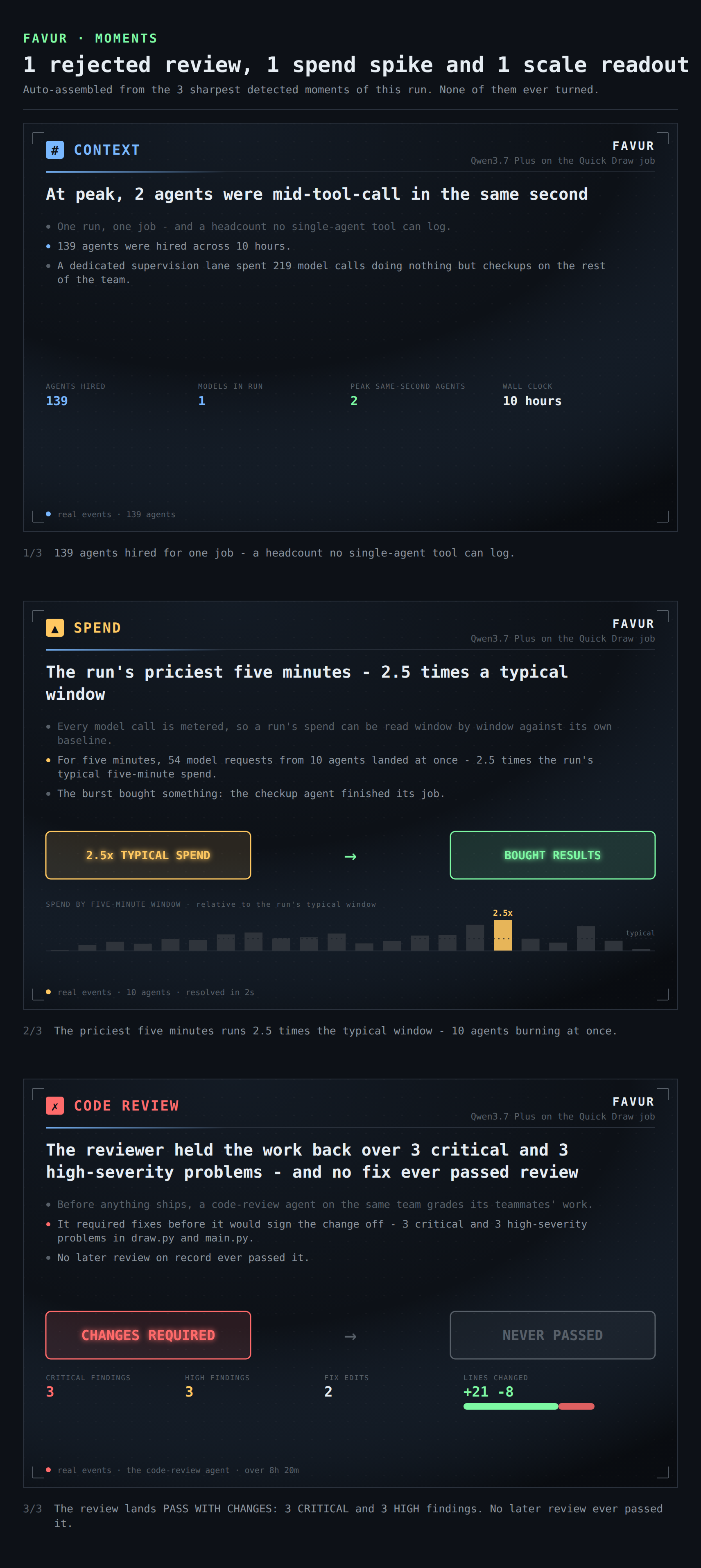
Animated reel: 1 rejected review, 1 spend spike and 1 scale readout. Auto-assembled from the 3 sharpest detected moments of this run. None of them ever turned. 3 moment cards with source code and transcript excerpts from the run telemetry.
The animated reel - the cards plus source code and transcript excerpts from the run telemetry. The full-size cards follow below.
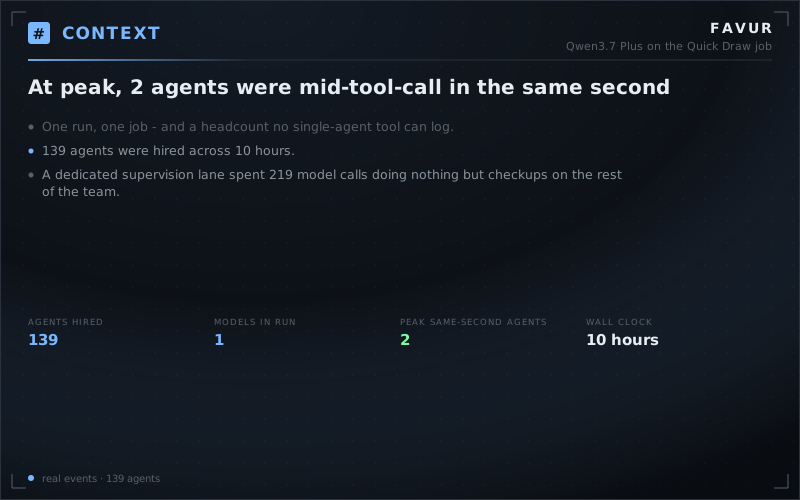
  1. At peak, 2 agents were mid-tool-call in the same second. One run, one job - and a headcount no single-agent tool can log. 139 agents were hired across 10 hours. A dedicated supervision lane spent 219 model calls doing nothing but checkups on the rest of the team.
    1/3 139 agents hired for one job - a headcount no single-agent tool can log.

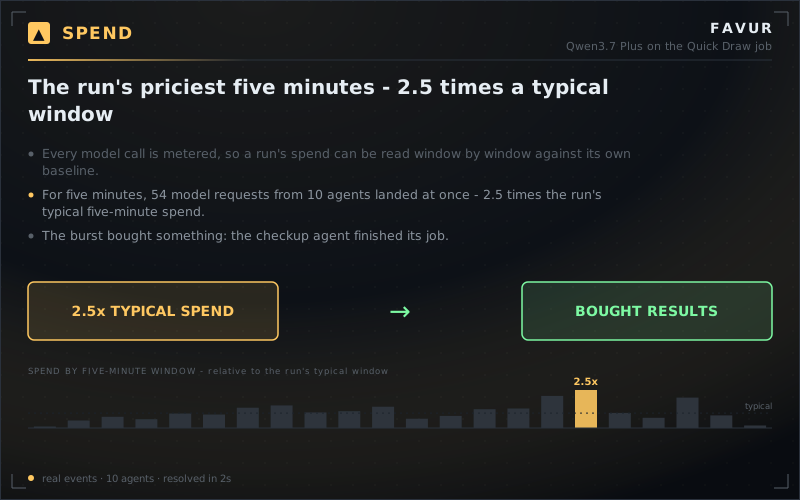
  2. The run's priciest five minutes - 2.5 times a typical window. Every model call is metered, so a run's spend can be read window by window against its own baseline. For five minutes, 54 model requests from 10 agents landed at once - 2.5 times the run's typical five-minute spend. The burst bought something: the checkup agent finished its job.

    2/3 The priciest five minutes runs 2.5 times the typical window - 10 agents burning at once.
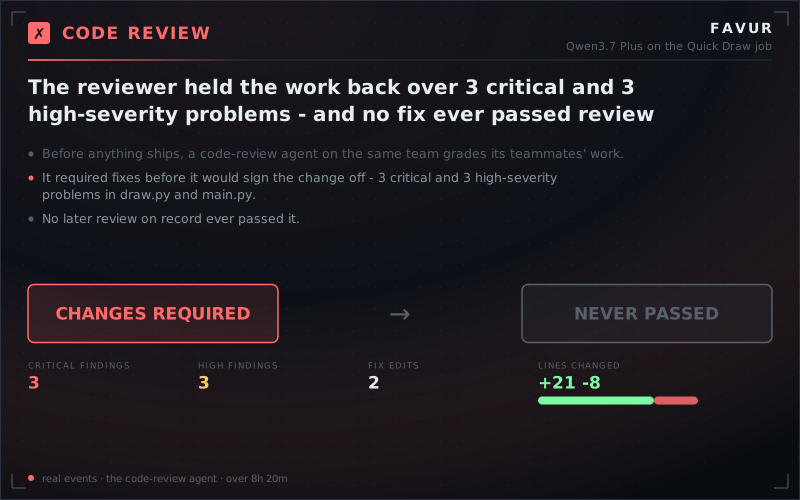
  3. The reviewer held the work back over 3 critical and 3 high-severity problems - and no fix ever passed review. Before anything ships, a code-review agent on the same team grades its teammates' work. It required fixes before it would sign the change off - 3 critical and 3 high-severity problems in draw.py and main.py. No later review on record ever passed it.

    3/3 The review lands PASS WITH CHANGES: 3 CRITICAL and 3 HIGH findings. No later review ever passed it.